

Happy New Year 2026 to everyone! 🥳
May it bring you health, serenity and happiness!

How is it going for you? I hope that on a personal level, you have more joy and satisfaction than on worldwide level… 😵
For me, this year is off to a pretty good start artistically:
I received a tabletop easel for Christmas.
It will be much more practical than my drawing table, which can only be tilted with the help of a second person.
I am really delighted to have regained a good posture for drawing!
Not only will this relieve my neck and back, but it will also relieve my right shoulder.
To achieve a smooth line, good shoulder range of motion is important.
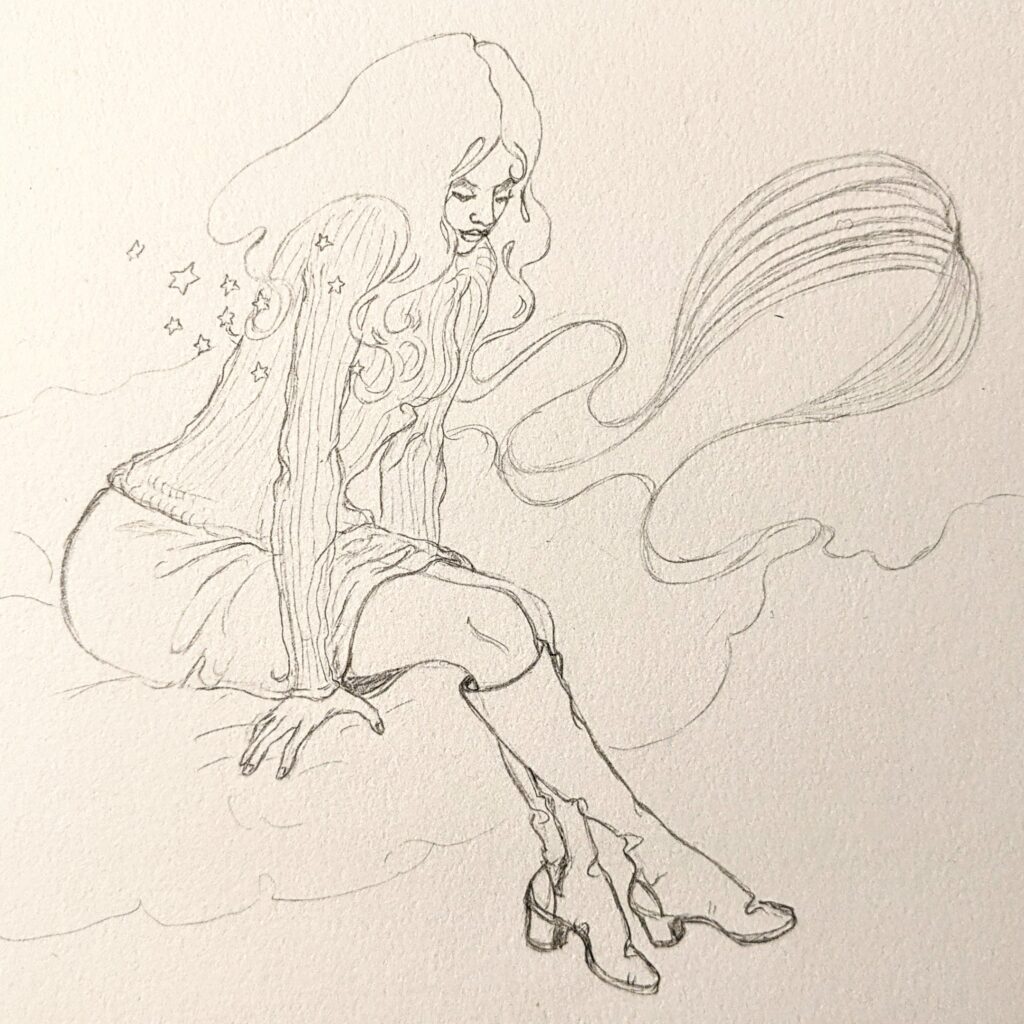
To celebrate, I resumed a project I started in November 2023.
This illustration was supposed to be the monthly reward for my Patreon subscribers.
Unfortunately, my second case of adhesive capsulitis flared up at that time.
Since then, as you know, my artistic and professional life has been at a standstill. It has been monopolised by rehabilitation and caring for my sick grandmother.
So it’s time to take advantage of the energy of January and make a real fresh start!
Good lighting and good posture
Before even thinking about finding a good posture for drawing, I wanted to make peace with my workspace, starting with the overall lighting.
A good lighting
Although my room is double-aspect, it lacks natural light. The window is not very large and the French window faces the setting sun.
This is very beautiful and inspiring, but not bright enough for my mood or for working.
Light-coloured walls

A few months ago, I felt overwhelmed by the darkness of my room. So I started tearing down the dark blue wallpaper from most of the walls.
There are still traces of glue, old pencil marks from the craftsman, and an entire wall to strip…
But it doesn’t matter: I already feel like I can breathe better.
When it comes to lighting, I’m a bit more limited because I don’t have a ceiling light.
For electric light, my room has to make do with a single small wall light.
Finally, to make matters worse, there are only two sockets in this room. One of them is already taken by the radiator and the other by my computer.
Of course, I use extension cords and power strips, but I try not to overload them for safety reasons.
Light, brightness, lumens
On my drawing table, I have an architect-style articulated lamp with a Unilux LED bulb.
I chose a 1,100-lumen bulb to ensure good lighting.
In terms of brightness, a bulb’s lumen rating is more important than its wattage.
This measurement indicates the amount of light emitted by a bulb.
However, this was not enough.
So a few years ago, I purchased a ring light/circular lamp from the NEWE brand.
It can be adjusted in terms of brightness (cool, warm) and intensity.
The whole unit is height-adjustable and can even be tilted.
The final advantage is that I can attach either my mobile phone or my digital camera to it.
All of this combined gives me enough quality light to work with.
Even on days when the sun is not shining.
Once the electrical work in the house has been completed, I will be able to improve my setup.
Unfortunately, this is still not the case.
Now that my studio was brighter and better lit, I could work in a good posture for drawing.
Good posture for drawing: a large-format tabletop easel
A brighter, properly lit workshop… that’s a good start, but a good workspace with a good slope… that’s still incredibly important!
The drawing table on which this easel stands was a gift from my grandmother over five years ago.
It is made of glass, so it is easy to clean and can be adjusted in height and angle.
At the time, it all seemed like a very good idea….
The tilting glass table: a not-so-good idea

Unfortunately, to change its position (whether in height or to tilt it), you need two people, turning knobs, holding the glass top, checking that it is level…
As you can imagine, this was not ideal for regularly changing the position and angle on my own.
When we lived in Toulouse, then in a rented house, my art studio and my husband’s were next to each other.
So, I could bother him between classes to help me adjust the table to a new position.
Since we moved, I’m on the opposite side of the house from his office, which makes things more complicated.
Add to that my long years of capsulitis and convalescence, and you will understand why the tabletop has remained horizontal for so long.
In addition to my shoulder problems caused by two successive bouts of capsulitis, I had to suffer from being bent over my work.
Because, as you may have noticed, my style is more miniature than large format.
Obviously, certain phases of my work are done flat when I use a lot of water in my watercolours, but for the next steps, I can raise my work and relieve my back.
Because I’m no longer 20 years old and rheumatism is lurking!
Returning to work after four years of capsulitis on a 100% horizontal work surface was very tiring, and I wondered how to solve my problem:
Should I tilt my table without being able to change its position for months, or should I find a new solution that is both practical and ergonomic?
So, when I was asked what would be useful to me, or what would make me happy for Christmas, the choice was easy!
The correct posture for drawing with a tabletop easel
However, I didn’t rush into it. I took the time to do some research to determine which easel would best suit my needs.
My criteria were simple:

- Easy to use
- Lighter weight
- At least four tilt positions depending on the stage of work and the amount of water used
- Minimum A3 size
- Solid, moisture-resistant board (since I work almost exclusively with watercolours)
- Minimum 1 cm rim so that I can place my watercolour board on top (there’s no way I’m stretching my paper on the easel, since I cut it with a craft knife once the illustration is finished)
After a quick overview and a browse through the Géant des Beaux Arts catalogue, I settled on a ‘Danube drawing table, 51 x 8 x 76 cm’, i.e. A2 size (non-sponsored link).
It is made of sturdy beech wood, has five tilt settings and weighs only 1.2 kg.
Finally, after thoroughly cleaning my studio, its cupboards and my supplies, I already felt better in my workspace.
A pretty linen tablecloth that was too small for our dining room table covered the glass top, and I was able to set up my brand new table easel.
It was finally time to resume this project that had been on hold for over two years.
What a joy to be able to work in the correct position again!
As a result, y shoulders are relaxed, my neck feels better, and as an added bonus, I have a better perspective on my work.
A good posture for drawing and resuming an old project
For now, I’ve raised the easel to the second-to-last level so I can pick up where I left off on this old project: transferred from my original sketch onto 310g/m² satin-finish Arches paper.
Good posture when drawing allows you to see mistakes more clearly.
Actually, when I took on this abandoned project, I knew I would only find faults with it.
But the vertical position of my work allowed me to take a step back and go further in my corrections, to be more efficient.
A few minor corrections here and there were necessary, particularly regarding the proportions of the head.
As for the rest, it’s just that I’m a bit of a perfectionist.
In fact, to tell the truth, I have to restrain myself because I shouldn’t be sketching/drawing on watercolour paper like this anymore!
Generally, once the drawing has been transferred to my Arches watercolour paper, I don’t use an eraser anymore so as not to weaken the fibre.
Once the lines are drawn, I lightly smudge them with a ‘breadcrumb’ eraser so that they don’t show through the watercolour (which, unlike gouache, is not opaque).
But that’s all, because I always make sure to transfer my drawing once I am 100% satisfied with it.
Good posture for drawing, painting and avoiding beginner’s mistakes
Unfortunately, this time, the drawing had been transferred in November 2023 from my sketch (which I thought was good and finished) on standard paper to watercolour paper.
With the benefit of hindsight, I inevitably find flaws in it and am forced to make corrections on my final medium.
However, this is the best way to damage the paper.
This is why I try to work in small strokes, with a very small eraser, and to use a ‘breadcrumb’ eraser whenever possible.
If I press too hard, I risk scraping the paper fibre and compromising all the watercolour work.
This is especially true since I sometimes use many layers of work, and always use several layers.
If the paper fibre gets worn down, the watercolour can smudge, making my lines less sharp…
And the paper could even tear where I’ve weakened it too much!
This is a silly beginner’s mistake, but one that happens very quickly, especially if you are a perfectionist.
To sum up : use small, delicate strokes, be patient, breathe, and remember that even when making corrections on watercolour paper, the best is the enemy of the good (yes, even on 310g/m² paper!).

A good approach for designing new projects and fulfilling custom orders
In any case, I now have a new setup and a good posture, so I can get back to work.
Whether it’s personal projects or commissions.
I’d also like to take this opportunity to let you know that my Etsy shop reopened on Monday, 12 January 2026, as did commissions for personalised portraits! 😉
Regarding orders and commissions for personalised portraits

Whether you want to give a portrait to a loved one or commission one of their favourite heroes, you are sure to make them happy.
No matter the occasion—Christmas, birthday, housewarming—a personalised, hand-drawn portrait is a thoughtful gift that is always appreciated.
Treat yourself to the services of a professional illustrator and receive a portrait in my style, created using ink, coloured pencils and/or watercolours, in A5 (14.8 x 21 cm) or A4 (21 x 29.7 cm) format!
For each format, you can choose the style of this portrait.
- Ink only
- Ink and coloured pencils
- Entirely in watercolour, without ink but with a touch of coloured pencils
Please let me know what type of portrait you would like:

- Face only
- Upper body
- Body down to the hips or waist
- Full-length character (for example, this portrait of Émilie Simon as a ladybird fairy)
Before ordering a personalised portrait and to find out more about the style of portraits produced, please browse the following links:
- Photos of examples on the product page of my Etsy shop
- My portfolio on my website
- My Instagram account, etc.
I will refuse any order asking me to work ‘in the style of…such and such an artist…’, thank you for your understanding.
Regarding other projects in 2026
As for the rest of my projects, I prefer to remain cautious, having become all too accustomed to seeing them ruined by unpleasant surprises…
Ideally, I would say: reopen my Patreon page, draw live on my Twitch channel, approach clients and publishers for inspiring projects…
So stay connected, subscribe to this blog and my newsletter, and feel free to follow me on social media—all the links are here.
See you soon, then, for more illustrated dreams 👁️ ⭐ ☁️ 🌈
Until then, take good care of yourselves in this sick, sad world.